Roast date now informs the recommendation.
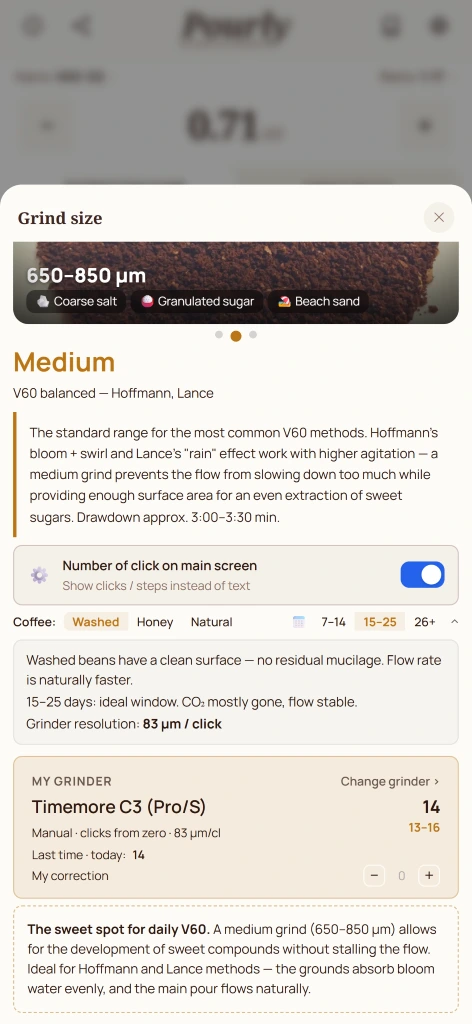
Save a roast date for each bag. Pourly considers coffee age when recommending a grind setting, while keeping your stock and brew history together.
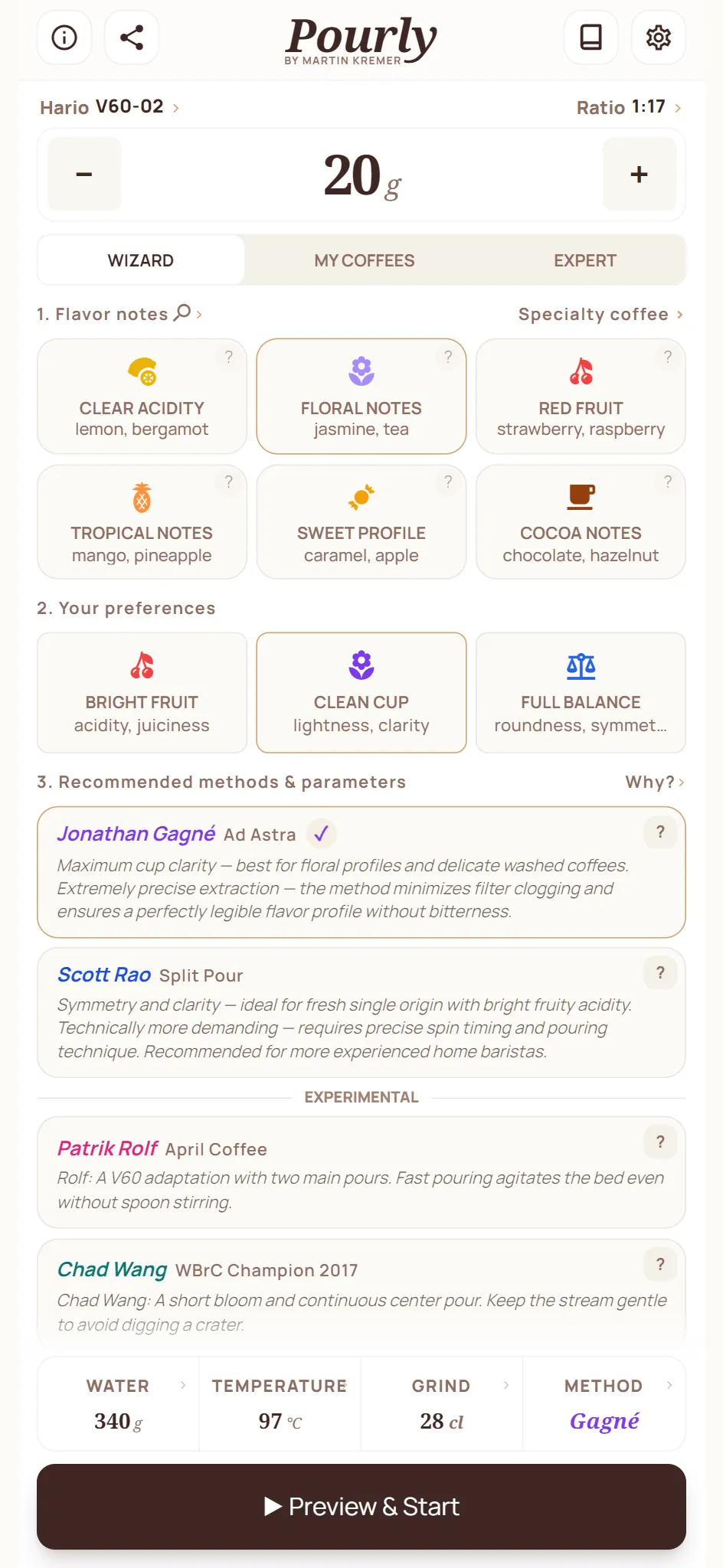
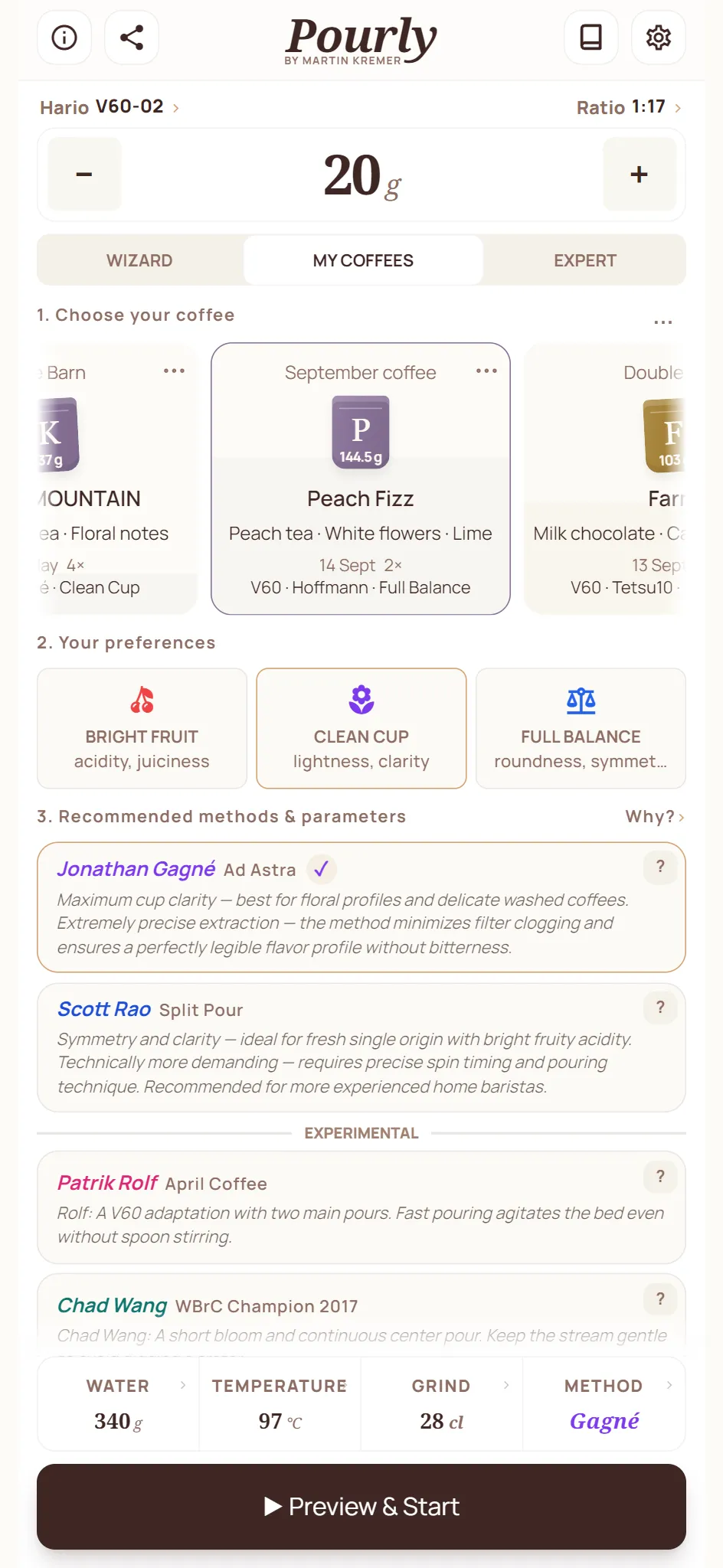
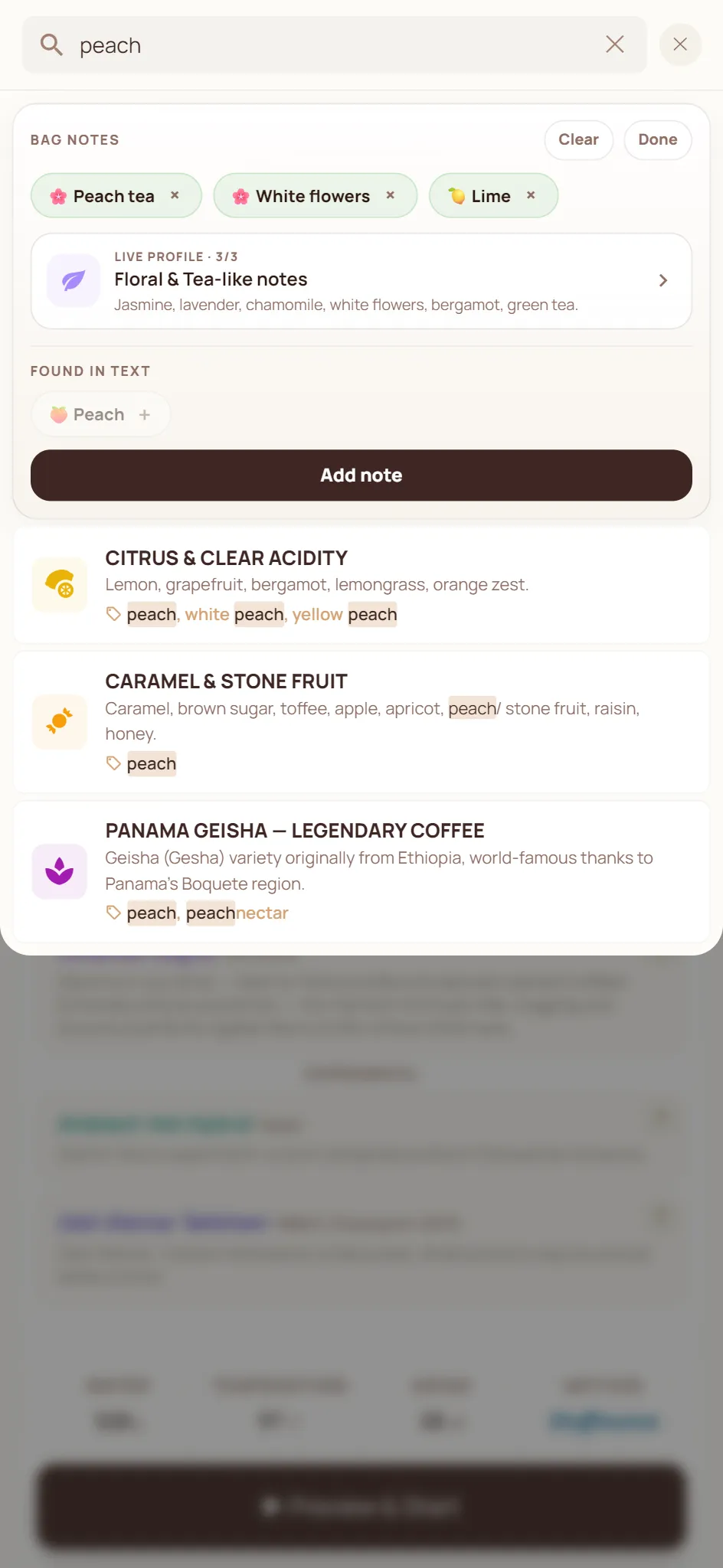
Enter up to three tasting notes from the bag, processing and what you want from the coffee. Pourly recommends a method, temperature, ratio, exact grinder clicks and a step-by-step guide — always with the reason behind those choices.
Every coffee is different. A washed Ethiopian and a Brazilian natural need a different approach — different temperature, grind, process. These four steps take that seriously.
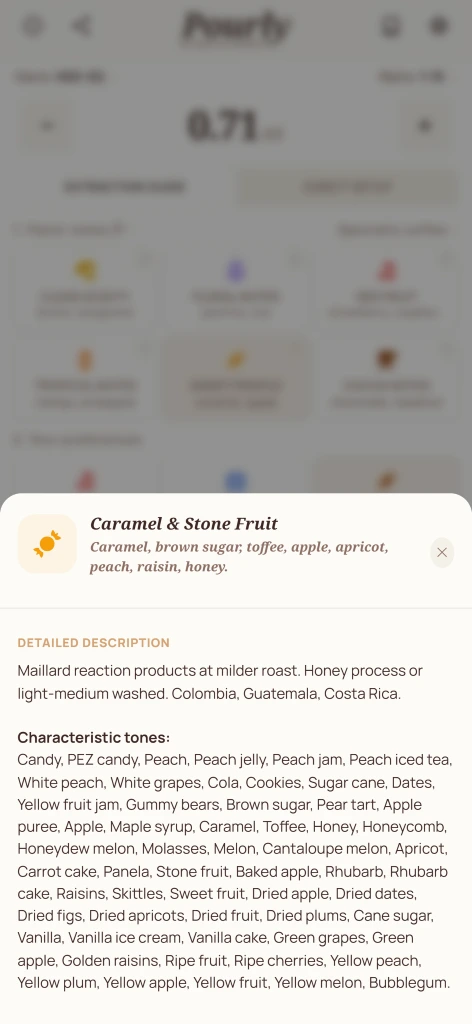
8 flavour profiles — citrus, floral, red fruit, tropical, chocolate, caramel, earthy, Panama Geisha. Or enter processing (washed, natural, anaerobic), age, and roast level. Pourly understands every combination and knows what it means for extraction.
8 profiles · processing · ageMost people learn one method and use it for everything. But a washed Ethiopian, a Panama Geisha, and a Brazilian natural need completely different approaches. Different temperature, ratio, grind. Pourly knows this. You get exactly what this combination demands — not a generic process.
Temperature · ratio · exact grind · recipe built for this coffee
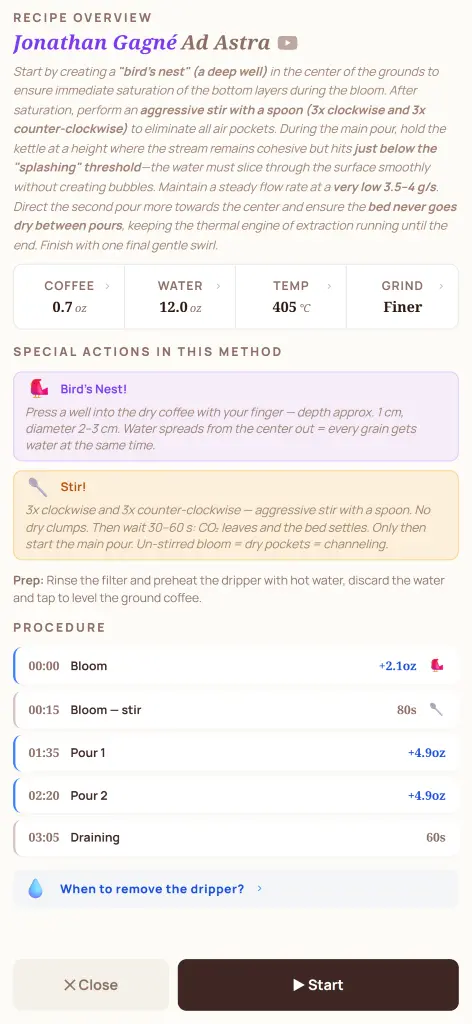
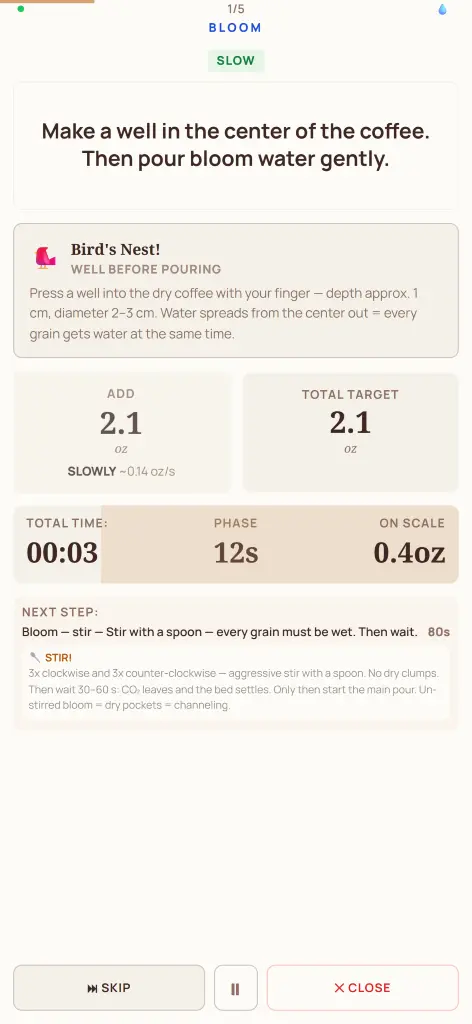
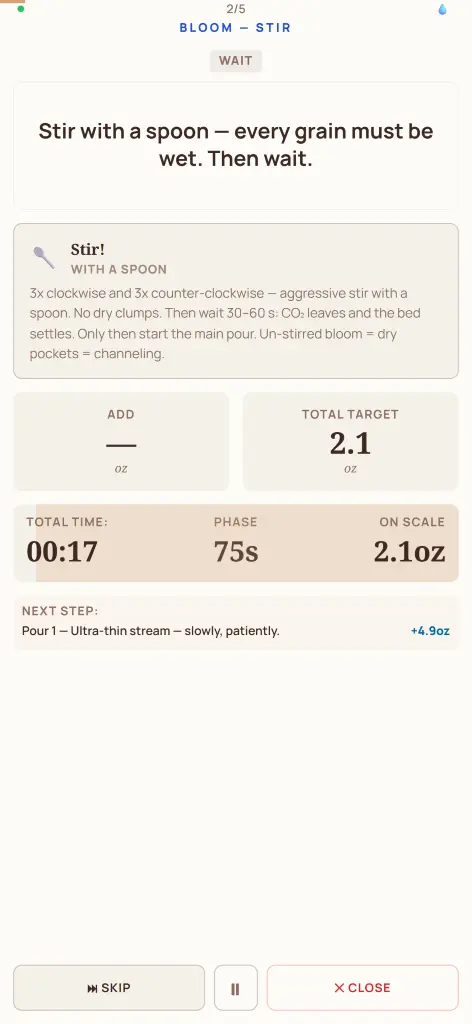
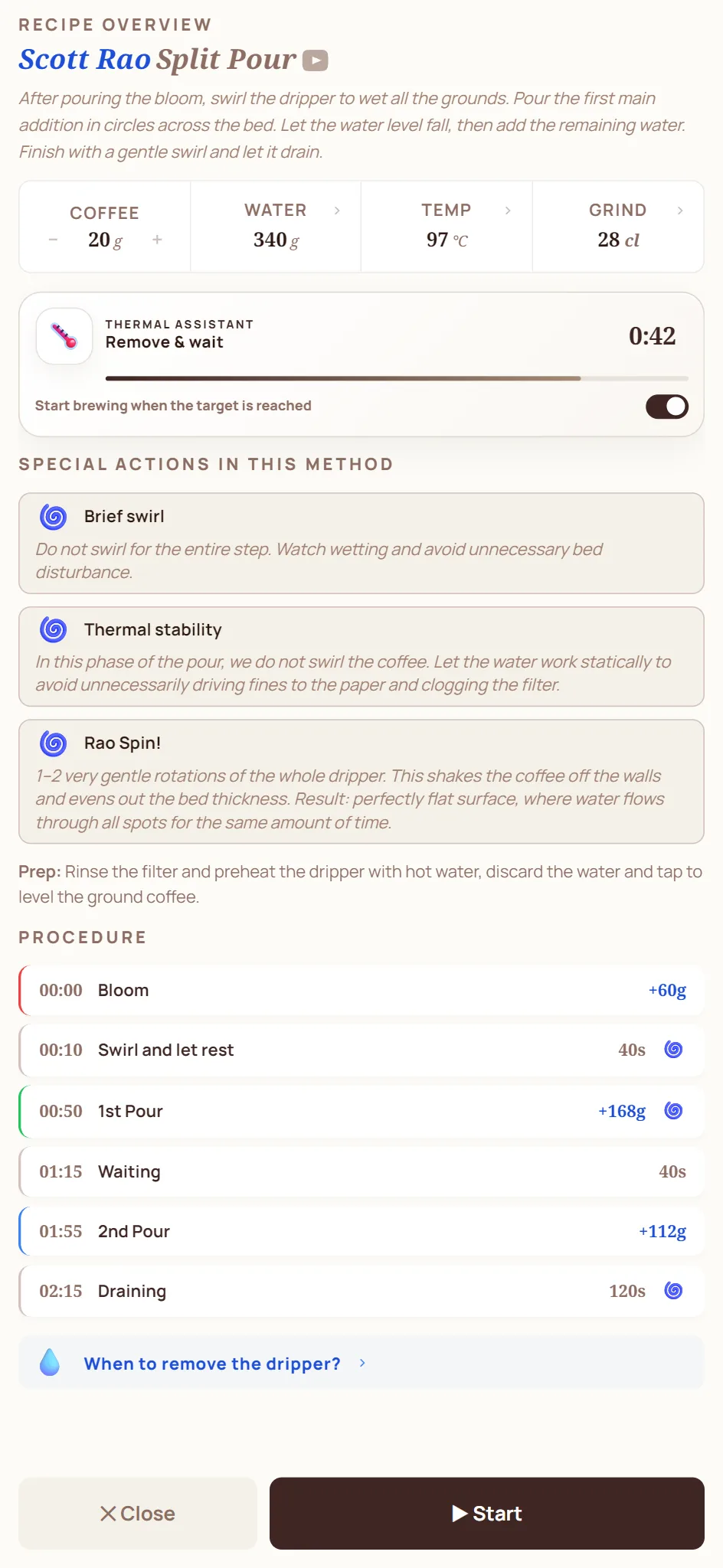
Bloom, Bird's Nest, Rao Spin, excavation — every step with a countdown and a tip that explains what's actually happening to the coffee at that moment. Not just 'pour 40 ml now'. But why now, why that amount, and what goes wrong if you do it differently.
Weight simulation · special techniquesStars, a quick note, done. Pourly remembers the coffee, grinder and brew result. The roast date and processing help it suggest a grind adjustment for that specific coffee and grinder — with your brew history ready for the next dial-in.
History · ★★★★★ · auto-correctionExplore the full Pourly journey — from choosing a coffee through recommendations and setup to guided brewing, history and further dialing in.


Four updates connect the coffee bag, brew execution and the moment you enjoy your cup.
Save a roast date for each bag. Pourly considers coffee age when recommending a grind setting, while keeping your stock and brew history together.
From a clear photo, the AI scan reads the roaster, coffee name, tasting notes and a clearly labelled roast date. Review the result before saving it.
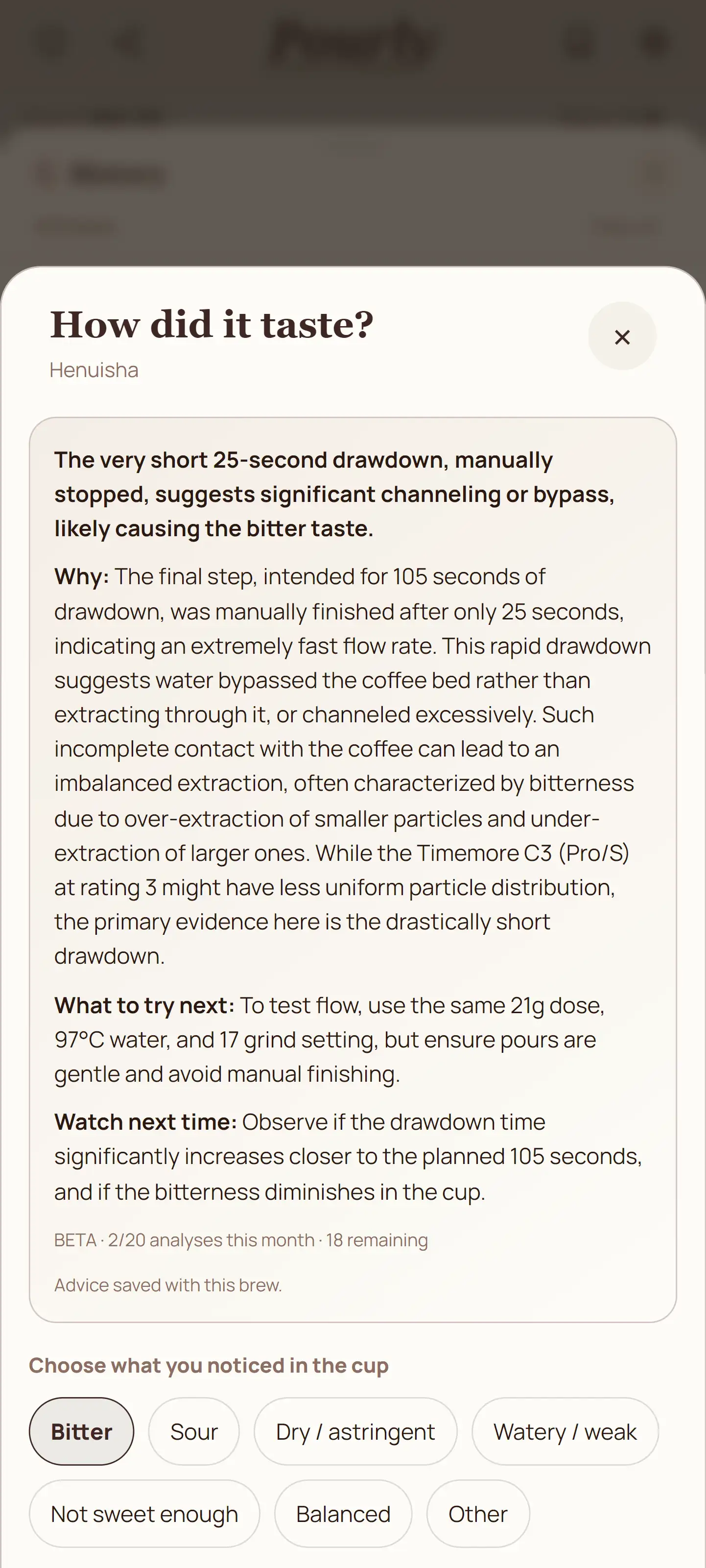
After brewing, tell Pourly how it tasted. The adviser considers your saved coffee, grinder, recommended recipe and brew execution — including drawdown when available — then suggests one cautious next step. Brew context and your feedback are sent to Google Gemini for analysis.
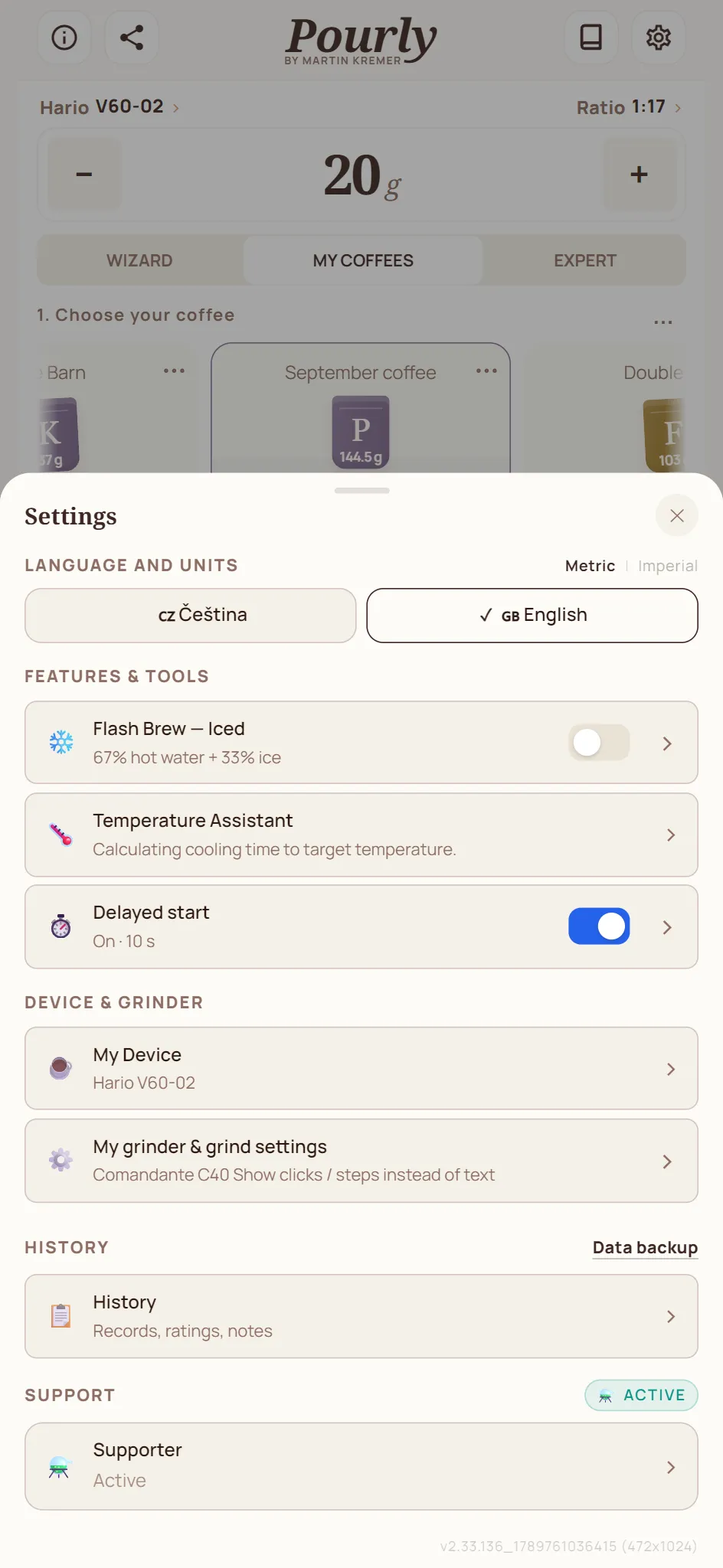
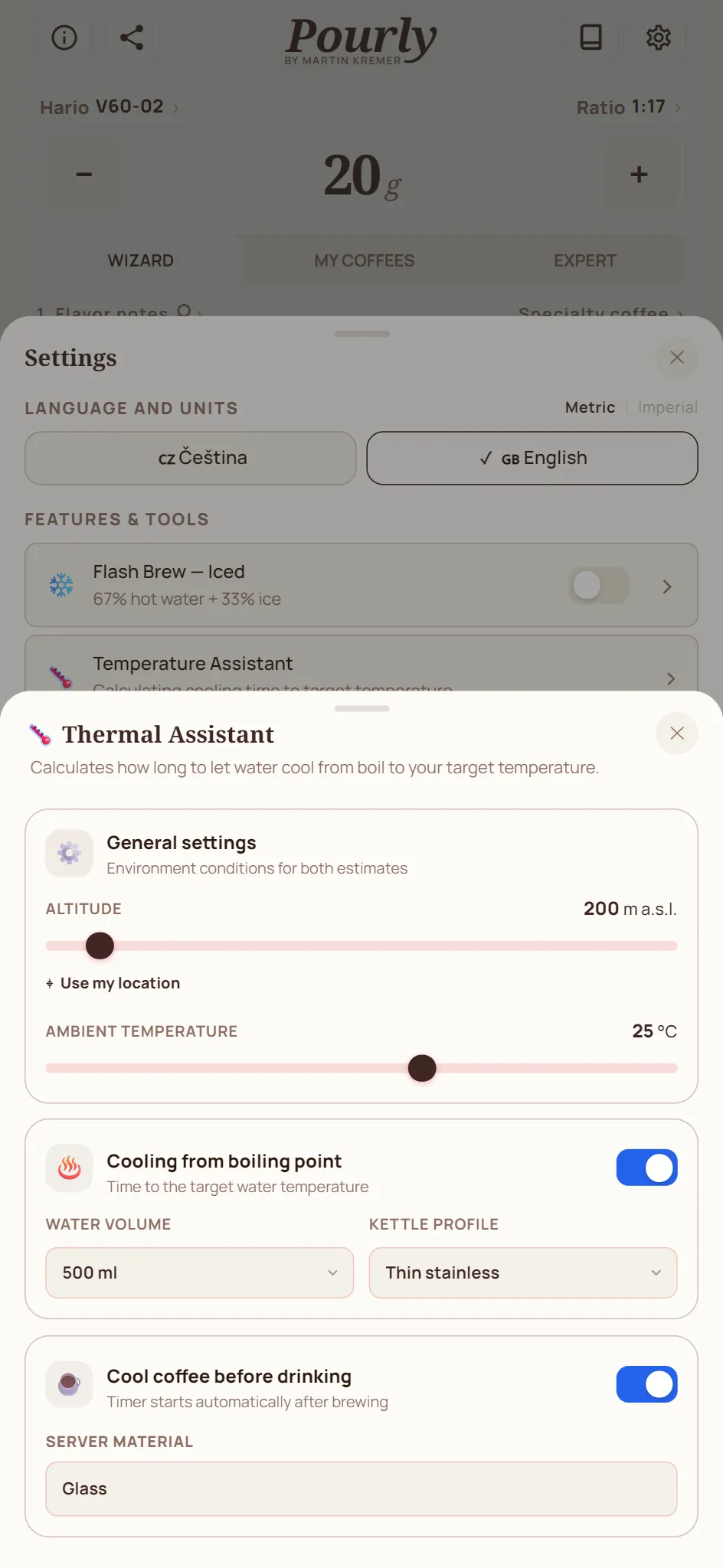
Before brewing, it estimates water cooling from volume, kettle profile, ambient temperature and elevation. When coffee cooling is enabled, it starts an estimate after the brew is actually finished, using flavour profile, volume, brew duration and server. It is a model, not a thermometer.
The brewer is only the start. Pourly connects the flavour profile with grind, temperature, ratio, method and the way you want to dial the coffee in.
Pourly translates its recommendation into a setting for your specific grinder, taking the coffee and method into account. Microns per click describe the grinder’s mechanical adjustment, not the particle size in your cup.
specific grinder · method · freshnessBefore brewing, it estimates water cooling from volume, kettle profile, ambient temperature and elevation; elevation can be set from your location. Once the brew is actually finished, it automatically estimates coffee cooling from flavour profile, volume, brew duration and server. It is a model, not a thermometer reading.
water before brew · coffee after brew · estimateSet ratio, dose and method manually and dial in yourself. Or let the wizard choose — the app works in both modes.
wizard or expertSearch for tasting notes in Czech or English. Pourly connects them with a coffee profile and recommends a method, temperature and technique.
3 notes · 8 profiles · bilingual searchChoose your model and Pourly translates the recommended grind into its specific setting. The range depends on both the grinder and brew method — the same click number does not mean the same thing on every grinder. Microns per click describe mechanical travel, not particle size.
Pourly’s AI works with the specific coffee and brew — not a generic question without context.
Photograph the bag and AI suggests the roaster, coffee name, tasting notes and a clearly labelled roast date. It preserves tasting-note wording from the package; review and edit the result before saving.
After brewing, it considers your rating, coffee, grinder, recipe and brew execution — including step timings and drawdown when recorded. It suggests one cautious next step.
A specific coffee, your actual grinder, real water temperature and the brew as it happens. Pourly connects the data to what is in front of you — not just to a line in a recipe database.
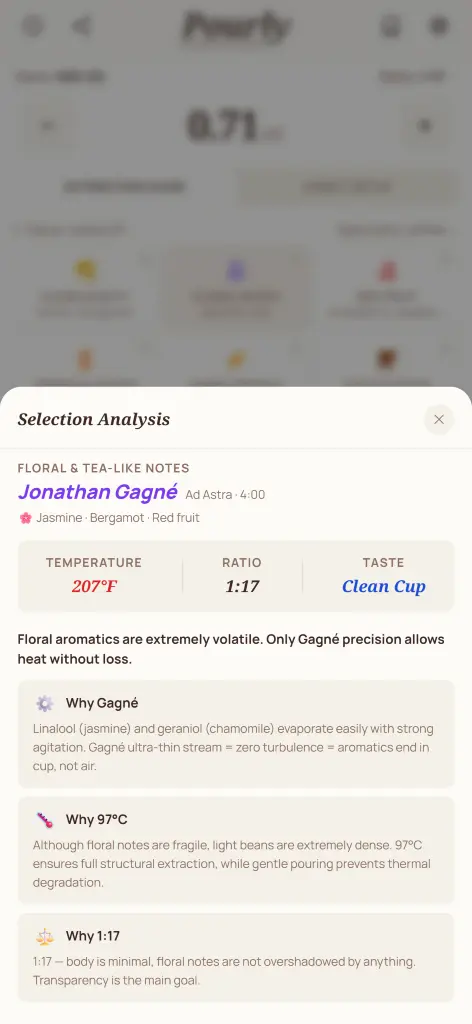
Linalool and geraniol (jasmine, bergamot) degrade irreversibly at higher temperatures. Pay thousands per kilo and you'll pull only citrus. Rao brews Geisha at 91–92 °C due to the Chemex filter's thermal mass.
Gagné / coffeeadastra.com · WBrC 2024Choose your grinder and Pourly converts the recommended grind into a concrete setting. For example, 24 clicks on a Comandante. It remembers the result after the brew, so the next cup does not start from zero.
Comandante · Timemore · Kinu · brew historyBefore brewing, it estimates water cooling from volume, kettle profile, ambient temperature and elevation — which can be set from your location. After the brew, it estimates coffee cooling from flavour profile, volume, brew duration and server. It is a model, not a thermometer reading.
Thermal assistant · volume · kettle · altitudeThese are only three examples. Inside Pourly, sources and rules turn into concrete settings, recommendations and guided brewing for each coffee and method.
Support unlocks the experimental V60 library, AI bag scanning and an AI brew adviser that analyses your actual brew.
Part of the water passes through the coffee and the rest is added to the server. Shorter contact can preserve a bright peak and soften a heavy finish.
An energetic start followed by cooler water across five pours. Built for sweet, layered fruit without a hard finish.
Inflow follows outflow without piercing the dome. The low water level aims for sweetness and a fuller texture.
The core of Pourly stays free. Supporters get the experimental V60 library, AI bag scan and the AI brew adviser in beta. Contributions help fund development, testing and the time it takes to build and improve new features.
Choose any amount above the minimum. I set the key validity according to the contribution and send the date together with the key.
A QR profile connects your coffee directly to Pourly. Customers review the preview and confirm to add the coffee to My coffees with its recommendation. Next time, they select it from their library and continue brewing.

Ten years ago a trip took me to Panama and I tasted Geisha for the first time. Light, delicate, astonishingly fragrant — in that moment I realised coffee could be a completely different experience. I've been chasing it ever since. And I went back to Panama — not just for the place, but for that feeling of where it all began.
I tried every brewing app I could find. They all told me how to brew. None told me why. Why this temperature. Why this many clicks. Why this method for this specific coffee. Pourly is my attempt to answer those questions.
You can use it simply — tap, brew, done. Or you can go deep — read every note, dial in, experiment. Both work. I built both on purpose.
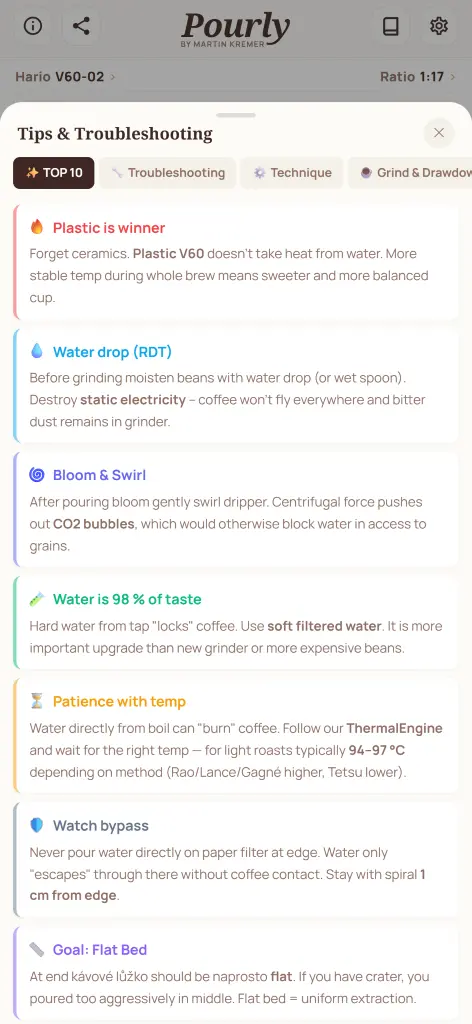
Bloom, ratio, washed and immersion appear on bags, in cafés and in videos from brewers around the world. Pourly uses the same terms — and explains what they actually mean.
A small amount of water (2–3× the coffee dose) poured over the grounds before the main brew. CO₂ escaping from fresh coffee would block even extraction — bloom 'drives it out'. Why English: this is the universal term; no other language's alternative has caught on.
Gentle swirling of the brewer just before drawdown — levels the coffee bed into a flat plane and improves extraction evenness. Named after Scott Rao. Why English: Rao Spin is a proper name for this specific technique; translating it would strip its identity.
The ratio of ground coffee mass to water volume. 1:15 = 15 g water per 1 g coffee (stronger). 1:17 = 17 g water per 1 g coffee (lighter, cleaner). WBrC champions choose 1:17–1:18 for Geisha for aroma clarity. Why English: 'ratio' is already universally used, even in Czech speciality cafés.
Cherries are processed wet — the pulp is mechanically removed, seeds fermented in water and dried. Result: clean, clear flavour profile with well-defined acidity. Least CO₂ after roasting — easier to extract consistently. Why English: an industry-standard processing term used worldwide.
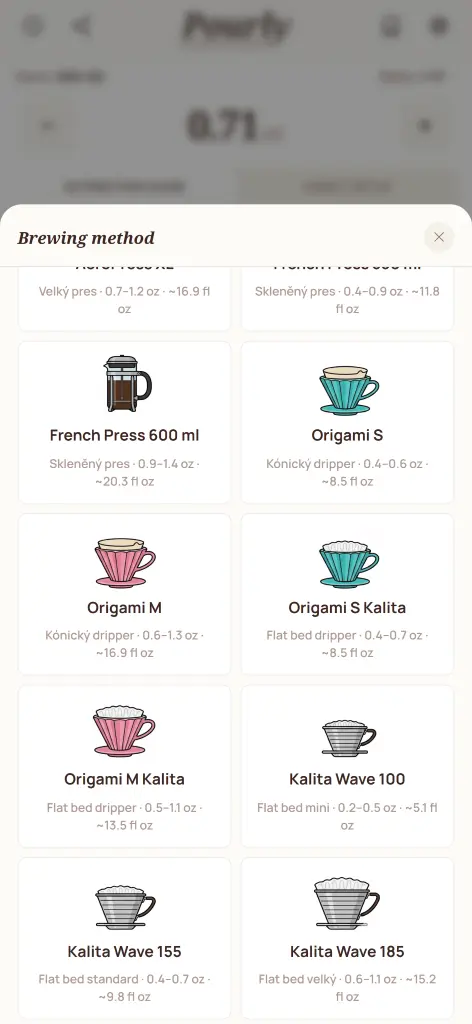
A brewing method where water is poured manually in controlled phases through a filter — unlike an espresso machine or French Press. Allows precise control of temperature, flow rate and turbulence. Covers V60, Chemex, Kalita, Origami and Hario Switch in pour-over mode.
Coffee is fully submerged in water for the entire extraction — like French Press or AeroPress. No water flow; extraction is static. Result: fuller body, less acidity than pour-over. Hario Switch combines both methods in one device with a switch on the bottom. Why English: "immersion" is already the international technical term.
Before bloom, use a chopstick to poke a divot into the centre of dry grounds — it looks like a bird's nest. Water spreads outward from the centre and reaches every ground at the same moment. Eliminates dry pockets and channelling. Why English: Gagné's original name, established in the community.
Use a spoon or chopstick to dig all the way through the coffee bed to the bottom of the filter — ensures water reaches the lower layers. Lance Hedrick requires it in his 1-2-1 method as an alternative to a gooseneck kettle. Why English: Hedrick's own coinage; no other name exists.
The hissing sound an AeroPress makes when the plunger reaches the coffee bed. Your cue to stop — the last millilitres drag fines and tannins into the cup, causing cloudiness and bitterness. Stop just before it. Why English: the community has no other name for this.
Water finds the path of least resistance and punches through the coffee bed in one spot instead of flowing evenly. Result: part of the coffee over-extracted (bitter), part under-extracted (sour). Bird's Nest and proper bloom significantly reduce this risk. Why English: a technical term with no established equivalent.
Total Dissolved Solids — mineral content of water in mg/l. Too hard (high TDS) mutes delicate notes. Too soft (low TDS) under-extracts. Speciality coffee ideal: 75–150 mg/l. The Scandinavian style uses ultra-soft water for maximum transparency.
Very fine particles produced during grinding even at the coarsest setting. They extract much faster than larger particles — causing bitterness and cloudiness. Premium grinders (Comandante, Kinu) produce fewer fines thanks to precision burr engineering. Why English: terminus technicus without an established equivalent.
Cherries are dried whole in the sun — the seed absorbs sugars from the pulp. Result: full body, fruity and fermented notes, more CO₂ after roasting. Pourly therefore suggests coarser grind for longer than with washed — the bed holds resistance longer. Why English: same reason as washed.
Cherries ferment in sealed tanks without oxygen — specific organic acids and alcohols develop, giving the coffee pronounced, sometimes wine-like or fermented notes. A recent innovation barely known outside English-language sources. Why English: no settled equivalent even in academic texts.
Pulp is partially removed — some mucilage (sticky layer) remains on the seed during drying. Flavour profile: between washed clarity and natural fullness. Holds lipids on the surface → slower flow; Pourly recommends a coarser starting grind. Why English: "honey process" is used even in Czech, though inconsistently.
Technique where a stronger concentrate is brewed and then topped up with clean water in the cup to reach final volume. Different results from diluting inside the dripper — water in the cup blends extracts differently. WAC (World AeroPress Championship) recipes use bypass extensively for single origin. Why English: technical term without an equivalent.
The shape of the filter space — instead of a cone (V60), the device has a flat bottom (Kalita Wave, Origami+KW). Every pour covers the full bed surface evenly. Result: more predictable, symmetrical extraction. Less dependent on pouring technique. Why English: an industry description of dripper geometry.
A kettle with a narrow, curved spout shaped like a goose's neck. Allows precise control of flow rate and pour placement — essential for Gagné Bird's Nest and Rao methods. Hedrick's 1-2-1 is deliberately designed not to need one. Why English: the universal product category name.
Now you know what to do with that. Let's brew it — Pourly tells you how, step by step, with explanations that actually make sense.